On being hungry
suffering, agency, and chronic illness

I’d not intended to take quite so much time off, but the last few months caught up with a sort of vengeance. On Ash Wednesday, one of my children asked if maybe I needed an ultrasound, “Are you sure you’re not pregnant?” He was hopeful that was the explanation for my tired crankiness1. It was one of those gut punch moments of motherhood. If my kid thinks I’m in the first trimester, this is a little worse than I thought2. How’s that for feeling your humanity on Ash Wednesday?
One of the factors in the recent fatigue was schlepping from one side of the country to the other and back for a family wedding. We arrived home in NC at 2 AM last Monday morning after traveling diagonally across the US. All things considered, the trip went remarkably smoothly, my sibling in law got hitched, the kids saw cousins, and there was chaos that all fell within the bounds of “large family event”.
However, that being said, I will confess to hitting my personal wall of “I can’t” at about 10:40 PM in the Atlanta airport, at which point I just wanted to be home. This reached a fever pitch as a certain toddler writhed around on the floor at baggage claim a couple hours later and we retrieved our mysteriously inky3 luggage from the carousel. Some moments you just have to survive.
Our trip’s smooth landing turned into more of a crash and burn when a doctor’s appointment just two days later threw me for an emotional loop. If you deal with autoimmune disease in the constellation of “poorly defined health issues that make you feel like your body is gaslighting you” you’ll recognize a process that goes something like this:
Body acts like a funhouse
Go to doctor, run labs, they are “normal” (if you’re lucky, by the time you have an appt. you feel fine!)
Doctor does the equivalent of this emoji 🤷♀️. Alternately, no one even calls you about the lab results and you google reference ranges and phone a friend
Feel insane
Internet research, podcast research, everything research
Varying levels of living life as if nothing is wrong while also wondering why occasionally weird things keep happening and if this is actually normal or maybe you’re truly just a dramatic wimp who’s also insane. Maybe everyone feels this way and you’re just incapable of handling pain?
Repeat every so often just for funsies
Now, in full disclosure, I have had some wonderful help along the way, and I was fortunate to find a practitioner who listened and was able to get to the bottom of some things some years ago. I’ve made so much progress, and a lot of the things I’m doing are working well. But it’s also been a decade or more of living with my body in various forms of cranky. Well managed cranky, but still cantankerous. I dipped my toe back into getting some answers over the last couple months, and imagine my surprise when instead of being brushed off, I came out of a recent appointment with a referral to a rheumatologist and a rather gloomy report of “progressive disease4”. It’s funny — it’s not like I’ve not been aware of this possibility given my symptoms, but hearing it come out of someone else’s mouth was jarring in a way I didn’t expect. Then I had the added frustration of trying to get a prescription re-filled and feeling like I was speaking a different language… “com-pound-ing phar-ma-cy”5, being told there’s a six month wait for the specialist etc… etc… I know this is just the way it goes with our medical system, but it makes me crazy. My Lenten discipline might be just making the next phone call.
In all of this, I find one of the most difficult tensions to navigate is that of suffering and agency. It’s not good that suffering and pain exist, and yet they do. So what do we do about that? How do you remain hopeful and take action, but not let that same action trick you into thinking you have control? Each flare or setback carries with it the accumulated weight of all the work I’ve done to gain ground. It’s one thing to be at the beginning of a “healing journey” when you’re desperate and willing to throw anything at the problem. It’s another thing to be a decade into the long haul, wondering which things are going to improve and which you just live with. I find it’s a constant battle to not sink into the shame holes here… If I had just… Maybe I could… If only…
If I just was omniscient and omnipotent I would know how to fix myself. Obviously.
Or would I? Would I know how to alleviate my own suffering? And do I really know what this suffering is for? I have such a limited view of the whole thing. Sure, I’ve exhaustively researched, certainly I can tell you all the details of various possibilities, and yet I find myself at an impasse, hemming and hawing because no one path seems particularly clear. The easiest thing in the world would be to shrug, keep soldiering along, and give up, because it’s too much work to find answers. It’s much more difficult to hold the line taut. Don’t give up. Wait. But for what?
I’ve been thinking of what it means to be hungry lately. Hunger is a primal instinct that drives us towards sustenance. Our needs, our growling stomachs, our thirst, propel us to take action. A lack of appetite is a sign that something is deeply wrong, and yet how often do we act like our desire is pathological? How dare we hunger and thirst? How dare we feel the aching need of all the things in our bodies and world that are not as they should be? It is far safer to deaden the appetite. I do not need, I do not want. I will not open the door to possibility, because the prospect of being disappointed is more painful than I can bear.
What would it mean to admit we are hungry, even if we cannot be satisfied?
If we’re honest with ourselves I think we are hungry for wholeness, peace, and joy, yet our hearts feel the ache of broken, painful, disintegration.
I’ve spent most of my life wondering if I could just be less hungry. Why can’t I just be happy with the status quo?
But then there are the Beatitudes:
Blessed are those who are poor in spirit, for theirs is the kingdom of heaven.
Blessed are those who mourn, for they will be comforted.
Blessed are the meek, for they will inherit the earth.
Blessed are those who hunger and thirst for righteousness, for they will be filled6.
Perhaps the same hunger that I often despise is what keeps driving me towards God.
Sometime within the last week or so, I read a portion of an essay that rang true:
To come before God and to ask Him to heal you, to bear your wounds and your heart in hopeful expectation that He might, is to risk the sting of His silence. Many millions have touched the walls of the grotto and left, physically at least, unchanged. There is a worldly sort of wisdom in conditional resignation, in accepting our lot and our condition with a kind of stoic peace. If we are not healed we may take it as a fact of life, or in a more despairing moment we can even blame ourselves for refusing to ask fervently enough to be changed. It is easier not to be angry with God when we can muddle through. It may be a worldly folly to hope wildly against hope, to hope in what only God can do when He so often doesn’t do it. But more than that, it is a spiritual risk, since it is haunted by the spectre that we may come to blame Him. It is easier to trust God when we have not really tried to follow Him or beg of Him, because we can always credibly retreat to blame ourselves.7
Every time I read a story of healing in the Gospel, I trip over it. They are all so different. I imagine the situations of each of the people who sought healing, and then I wonder about all the others who followed Jesus but didn’t receive the physical healing they longed for. Sometimes the stories of healing make me angry. Do they set a false expectation that our physical bodies will be restored miraculously? Some people still seem to think that illness is a lack of faith, that suffering is a sort of sin calculus, “Who sinned? This man or his parents?”8. I struggle with things like the Sacrament of the Anointing of the Sick. What is it supposed to do? Does traveling back to my pew a little more oily really mean it’s efficacious? Wouldn’t it be so much less risky to stay seated? Then the Gospel speaks:
“Those who are well have no need of a physician, but those who are sick. Go and learn what this means, ‘I desire mercy, not sacrifice.’ For I have come to call not the righteous but sinners.”9
Perhaps mercy comes when we receive it. If we are hungry, we shall be fed. If we mourn, we will be comforted. My baby cries and I answer him — he has not yet learned to be ashamed of his hunger. In this season of being ever more aware of our own hunger, may we receive the words of hope as they come:
If you lavish your food on the hungry
and satisfy the afflicted;
Then your light shall rise in the darkness,
and your gloom shall become like midday;
Then the LORD will guide you always
and satisfy your thirst in parched places,
will give strength to your bones
And you shall be like a watered garden,
like a flowing spring whose waters never fail.g
Your people shall rebuild the ancient ruins;
the foundations from ages past you shall raise up;
“Repairer of the breach,” they shall call you,
“Restorer of ruined dwellings.”10
Children’s Literature Corner:
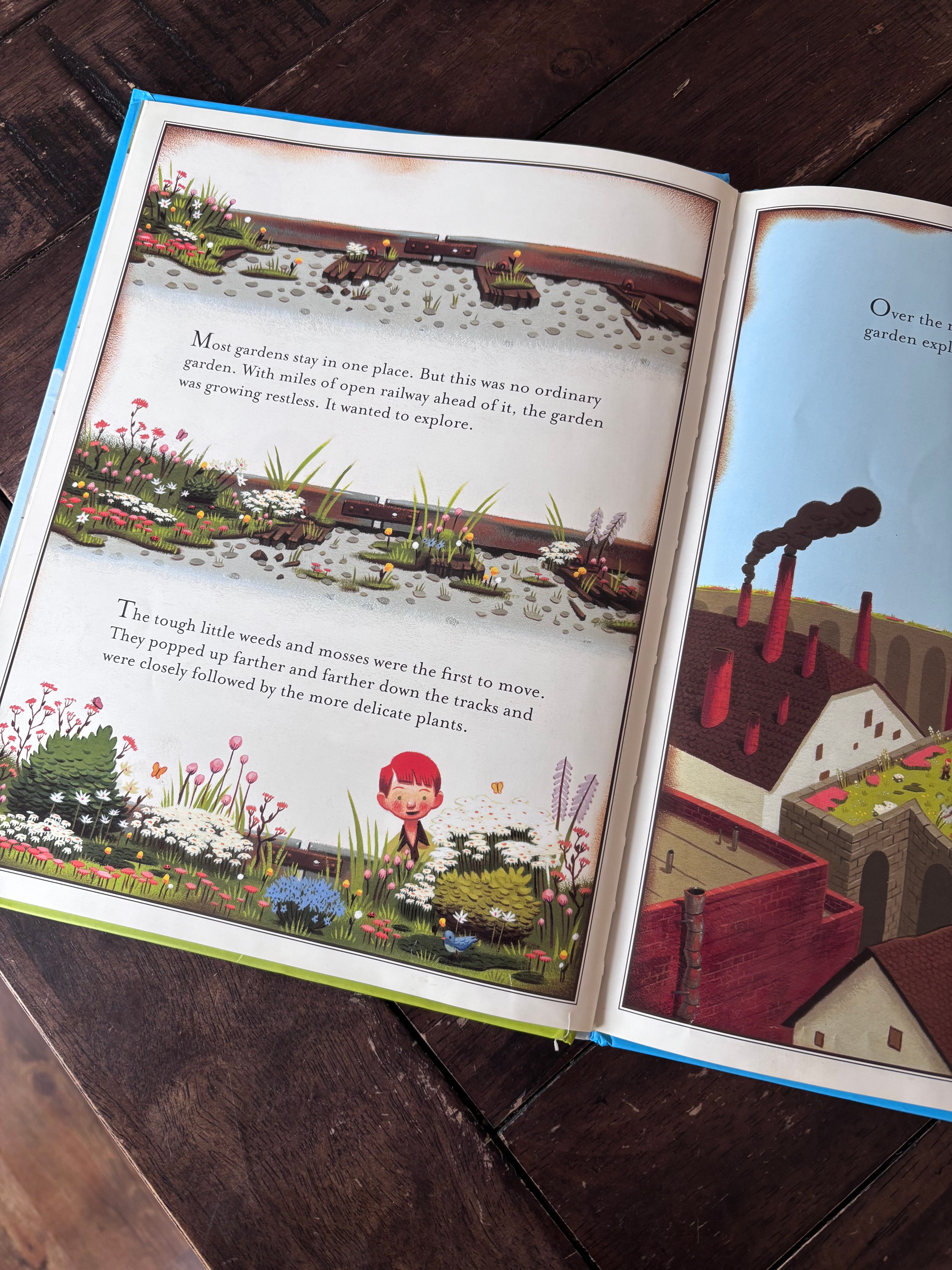
My husband used to work for a landscape company whose landscape designer was fascinated by the High Line and the gardener — Piet Oudoulf — responsible for designing its unique gardens. Think, A Pattern Language, but for plants. I’ve never been to NYC to see the High Line, but this book, The Curious Garden by Peter Brown is a charming introduction to the nature that took over an abandoned NYC railway and was eventually cultivated into the High Line. The book follows the growth of a tenacious patch of garden, tended by a little boy, Liam. It’s a lovely introduction to gardening in general, but it’s also fun to learn about the real garden that inspired it.
In Piet Oudoulf’s own words:
Gardens are allowed to change. Trees grow. For me, plants are personalities, plants have character. You put them on stage and have them perform. So a garden is not only a sort of community of personalities that like each other, it’s also a sort of stage play. We are not creating wilderness. We are creating gardens. The High Line is one big garden, so we have to see plants as having a personality—otherwise, you cannot put them in the right place. You have to think of a garden as a community and plants having companionship.
If you’d like to have full access to the archives, you can upgrade to a paid subscription. I keep these posts free for several weeks, but there’s a lot buried in the archives. All my content on autoimmune “stuff” and managing the “everything free” life is under this tab.
If you know someone who might appreciate this newsletter, would you take a moment to share it via text or social media, or by forwarding this e-mail? Word of mouth remains the best way for writers and readers to find each other. It’s harder and harder to find the good stuff in the AI slop.
And, if you’d just like to cheer me on but can’t commit to a paid subscription, you can buy me a cup of coffee here…
Lately:


Garden: I ordered seeds, but this year I’m paying attention to varieties since we are in such a tricky growing climate; I’m hoping that selecting for more heat tolerance and fungal resistance will help. I’m excited to see how the raised beds fare in comparison with the in the in ground planting we did last year. We are still doing a combined garden for some crops, but I think there will be a lot more landscape fabric involved ;) I have cabbage seedlings sprouting in milk jugs, so here’s hoping they survive to transplanting.
Listening: I don’t always line up with everything these ladies say, but thought this episode was one worth sharing, simply because it’s a women’s health topic that’s not talked about much.
Reading: I’ve finished the first two James Herriot books — delightful and good travel reading. I also read Nora McInerny’s Bad Vibes Only, which was quite funny in places. I’ve been an intermittent listener of her “Terrible, Thanks for Asking” podcast and am grateful for the dark humor. IYKYK. Kristin Lavansdatter eagerly waits for me to get past the first 30 pages. I have started, but I’ll confess to spending more time on medical Reddit than reading this last week.11Related to the gardening topic, this article about rhythm in planting, liturgy and home life is a great read (also written by the aforementioned landscape designer who happens to be a homeschooling mother of many herself).
Cooking: I got my new sourdough starter up and running and made two thoroughly mediocre loaves. Have to start back in somewhere! I also made a Lenten “decide once” and have been cooking a huge batch of black beans in the crockpot every Friday. Remembering to soak the dried beans is always my downfall, so making it a routine event helps, and at the rate these people are eating I can tell them to put some beans with their chips for a snack.
This kid also loves babies so much, so there was genuine sadness involved that it wasn’t the cause of Mommy’s crankiness.
My husband hates this word — he says it evokes a sort of disorganized shuffling and he aspires to order. LOL. I mean, I think this is subjective. He is the eternal optimist and not easily overwhelmed by our crew. Any time we have that many people it inevitably feels like schlepping to me: “to proceed or move especially slowly, tediously, awkwardly, or carelessly” according to Webster. Tell me that’s not an accurate description of getting 8 people, 2 car seats and assorted luggage from one coast to the other…
Some fellow passenger explained exactly what fluid from the plane got on our baggage and seemed askance that I wasn’t going to put in a damage claim. I told him, “These suitcases are at least ten years old and we just need to get home”.
Why is it always “you’re normal” or “this is progressive, you’ll need a biologic”. Where’s the “it’s a thing, but you can probably manage it”? And then who knows, you go see someone and they brush the whole thing off and you’re right back where you started.
PSA: Always call the pharmacy. Then call the provider. Then call the pharmacy again. Be polite, but annoying persistent.
Matthew 5:3-6
From this article h/t to Haley Baumeister
John 9:2-3
Matthew 9:12-13
Isaiah 58:10-12
(🙄…Annelise…you know better!)
The struggle with chronic illness, especially as a woman whose natural cycle brings such contant episodes of ebbs and flows is so real! And difficult. I believe alot of the negative effects of our modern world is seen first and especially in women's bodies. Thanks for speaking to it well! Praying you find relief and health in all aspects of your health journey.
Your family is beautiful, thanks for sharing snapshots :)
I've done plenty of the 'normal - normal - normal' doctor visits and lab visits and rotations over the years. I completely understand the exhaustion!!! I hate when people say this because it sounds dismissive, but have you looked into some of the 'body keeps the score' type issues? Jen Fulwiler talked about how she had chronic pain for literally a decade before she discovered physical methods of processing trauma/stress responses - and.. she's better! Now she also has a blood clotting disease etc. so there is real 'medical' stuff to do as always, but there's a significant mind/body connection that in my experience has often been of the stumping-the-doctors variety. It's also frustrating because it feels less 'real' but it's truly not. The pain/symptoms/fatigue is absolutely real. I think we're just a little confused on the causes/cures. these are some beautiful thoughts on hunger and expressing need/want - it can be such a frustrating process. Your seedlings look lovely - ours have really sprouted, it's exciting!